



Wolfwood tells the story of Indigo and her mother Zoe, the art world’s It Girl, who stunned with her Wolfwood series in the 1990s. Since then, Zoe has stopped painting, become debilitated by mental illness, and, along with Indigo, dropped to the very edge of poverty. It’s at this point that seventeen-year-old Indigo, desperate for money, takes her mother’s abandoned sketches and begins forging her mother’s work. In secret. Lying to Zoe, her friends, and the high-powered art gallery that is building a massive media campaign around the return of the Wolfwood It Girl.
The stakes are high. And Marianna creates a page tuner, weaving together themes of the risks we will take for family, the shame of poverty, and the blurred lines between creative genius and mental illness.
Marianna reveals the answers by intertwining Indigo’s present with her mother’s past and, incredibly, by submerging the reader into the painting process. The creation of the Wolfwood series sometimes feels like fantasy. At other times, it feels like a virtuoso’s out-of-body experience, as if Indigo is giving herself up to the very mental illness that is haunting her mother. To find out which it is, you’ll just have to pick up a copy of Wolfwood.


Indigo and her mother, once-famous artist Zoe Serra, have barely been scraping by since her mom’s breakdown. When a gallery offers Zoe a revival show for her unfinished blockbuster series, Wolfwood, Indigo knows it’s a crucial chance to finally regain stability. Zoe, however, mysteriously refuses. Desperate not to lose the opportunity, Indigo secretly takes up the brush herself.
It turns out, there might be a very good reason her mother wants nothing to do with Wolfwood.
Painting submerges Indigo into Wolfwood itself—a dangerous jungle where an army of grotesque, monstrous flora are in a violent battle with a band of girls. As Indigo enters Wolfwood again and again, the line between fantasy and reality blurs. It’s a tenuous balancing act: keeping her forgery secret and her mind lucid, all while fighting her attraction to Kai, the son of the gallery owner.
And by the time Indigo realizes the true nature of the monsters she’s up against, it might be too late—and the monsters might just win.
Before you head off to read Wolfwood, let’s get to my questions. Well, maybe it’s just one question divided into subparts. How did she do it? How did she convert the delirious act of painting to words. How did she draw such vibrant images of the characters—particularly through their fashion choices. What was the inspiration that drove her to write this astonishing novel? And last of all, how did she even find time to write it? Marianna is not only an author, she is a full-time developmental editor at Dovetail Fiction, the YA arm of the book packaging company Working Partners.
I’ll turn things over to Marianna now so that she can answer some of these questions and tell us What Was on her…
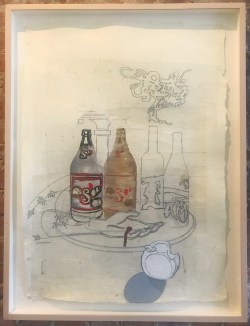
Walls: Before I became a writer, I spent over a decade working at a contemporary art gallery in Manhattan— a main source of inspiration when writing Wolfwood. Through the gallery, I got to know amazing artists and began a collection of small(ish) artworks. (I live in a studio apartment in Brooklyn, so I have limitations!) It would be hard for me to overstate how important the art I live with is to me. Less like decoration, more like…roommates? Recently, I’ve realized that several of the works share similarities with the books I write. They blur the lines between fantasy and reality. They tell stories, but don’t offer all the answers. They’re open-ended.

Clothes hangers: In writing Wolfwood, I let myself live out some fantasies through Indigo. She’s a lot of things that I’m not but would like to be. (Tall!) Among these, she’s stylish and edgy and aspires to be a fashion designer. Clothes are her passion and her armor. She finds ways to put together thrifted pieces so that you’d never know she and her mother live in poverty.


Bookshelves: While I’m working on a project, I have a section of my shelf/desk piled with relevant reference books—research, inspiration, craft….
The one I reached for the most while writing Wolfwood was The Marbury Lens, by Andrew Smith. Wolfwood contains three separate, interwoven stories: Indigo’s contemporary real-world story, her story inside the fantasy world of the Wolfwood paintings, and a story that takes place in Tulum, Mexico in 1989, when Indigo’s mother Zoe lived there. It was especially challenging to figure out the mechanics and rules of how Indigo enters Wolfwood and how her time in Wolfwood affects her real life. Smith masterfully handles a dual-narrative plot, with the character living one life in the real world, and another in a fictional world called Marbury that he enters when looking through a mysterious pair of glasses. Although the mechanics in Wolfwood are different, I looked closely at why I find The Marbury Lens so effective and what tricks Smith uses to keep tension in both threads, and I analyzed how he creates a suspension of disbelief in the mechanics. (I mean, even saying it here it sounds a little silly. The character looks through a pair of glasses? But I promise, it works!)

Calendar: Like most writers, I have a day job, and balancing work and writing can be tricky. But I’m extremely lucky in that my day job is as a developmental editor for a book packager, Dovetail Fiction/Working Partners. I work with a team of editors to come up with ideas for YA books, plot them, and hire authors to write them. Our agent then sells the books to publishers, and I help edit throughout the publication process.
During my seven years at Dovetail, I’ve learned so much about crafting novels. But just as importantly, I’ve learned how to differentiate between ideas that I think are great ideas, and ideas that are both great and that I would want to write myself (as opposed to suggesting at work). So, aside from strengthening my plotting muscles, my editing experience helped me access what made Wolfwood a story that I wanted to tell myself.
Heart / Mind: My first priority with all of my books is to tell a good story. But I also aspire to explore deeper issues through the narrative. The emotional/thematic heart of Wolfwood is the impetus many of us feel to try to fight our loved ones’ battles for them. In Wolfwood, I made this literal – Indigo is fighting monsters that her mother created when she’s inside the world of Wolfwood. But that’s just a new iteration of what Indigo has been doing for years: trying to save her mother from her emotional demons. And what Indigo comes to learn is that while she can support and love her mother, Zoe has to save herself.
I think this can be especially hard to learn in parent/child relationships—parents trying to fix everything for their children and children feeling responsible for their parents. The burden on a child who feels they need to save their parent is complicated by the fact that it’s a reversal of the caretaking relationship. Seeing someone you love struggle can be intolerable; I think it’s important to learn how to create healthy boundaries, while still being loving and supportive. I’m hopeful that Indigo’s story is a good example of a young person coming to that realization.


Once again, a huge thanks to Marianna for stopping by, answering my questions, and giving us this behind the scenes tour of Wolfwood.
If you would like to order Wolfwood, you can find it at Abrams Books, Amazon, Barnes & Noble and Bookshop. There is also an audio version, which I can highly recommend.