

As an American abroad, I live a strangely dystopian life as a reader. I inhabit a land without bookstores. Well, not exactly devoid of them, but without shops selling books in my preferred language. No thrilling displays of the National Book, Newbery, or Caldecott winners. Not even of Britain’s medallists. Every English-language book in my library crossed the Atlantic or Channel concealed within a suitcase or brown box.
This works fine for novels. I scour reviews, blogs, facebook, and twitter. Matchmaking friends know what I love. A book crosses the border. I read. And I am happy.
But I am a reader of myriad forms—nonfiction and poetry, thick novels and slim picture books. And it is this last form that most often causes me trouble in this land without English bookstores. You see, I lack the ability to discern at distance whether a picture book is one I will love. I am unable to judge a picture book by its cover—or even its blurb. Having to pay international postage and wait two weeks to be reminded of this failing only makes it worse.
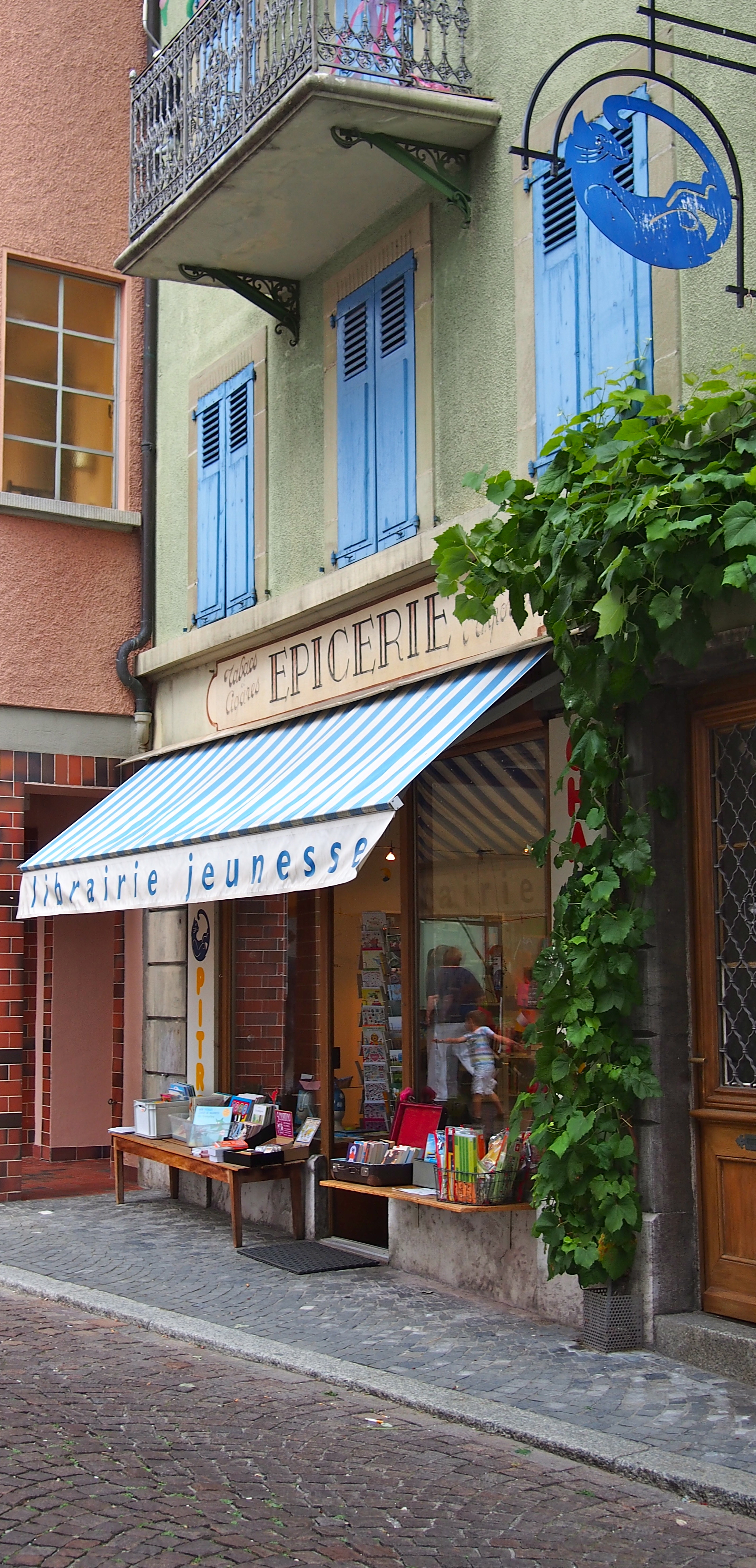
Cha-Pitre, Lutry, Switzerland
The solution I have found is to indulge in French picture books. When I am craving something new, I head down to a magnificent little bookstore, called Cha-Pitre. Switzerland’s own French-language population is too small to support the publication of more than a few picture books each year, so most of Cha-Pitre’s “albums,” as they are called, come from French publishing houses.

Une Soupe au Caillou
Anais Vaugelade
The local doyenne of children’s literature, Isabelle Troyon, runs Cha-Pitre, and Isabelle is a true romancer of stories. I don’t think I’ve ever left her with less than five books in my arms. She introduced me to my favorite telling of Stone Soup, Une Soupe au Caillou, and my favorite short love story, Un Amour de Bouton.
But there are cultural differences, for sure, between the American picture book and the French album. The French seem to forgive a lot in a story if the graphics work. The story can be targeted toward parents, not children. It can be abstract and nonlinear, even difficult for an adult—at least, this adult—to understand. And it can be much more frightening than what we are used to presenting to children in America. See, for example, the books in this article from The Guardian.

Un Amour de Bouton
Pauline Carlioz
Reading through albums that don’t quite work for me has increased my belief in the importance of story. Story, that is, with a capital S. No matter how gorgeous the book, no matter how much Isabelle and I might sigh over the artwork and the weight of the paper, the book isn’t a picture book for me unless it includes a story that will entertain and capture the imagination of children, a story that a child will want to reread the moment she has finished the last page. I love what Anita Silvey calls the picture storybook. I love what Viviane Schwarz calls “32 pages of performance… Thousands of copies, each one a paper theatre.”
So, while I’m here in Switzerlnad, I’ll keep searching out the jewels like Une Soupe au Caillou and Un Amour de Bouton. And the next time I’m in America, I’ll be sure to stop by shops like Books of Wonder and The Flying Pig so that I can stuff my suitcase with as many paper theatres that I can.
Sandra Nickel sandra nickel sandra nickel sandra nickel sandra nickel sandra nickel sandra nickel